Maryland's Six Casinos Post $148.5 Million Revenue in February 2026, Down 4.3% from Prior Year
Written by Katja Neumann · Mar 11, 2026

Maryland's Six Casinos Post $148.5 Million Revenue in February 2026, Down 4.3% from Prior Year
The Latest Figures from Maryland's Gaming Landscape
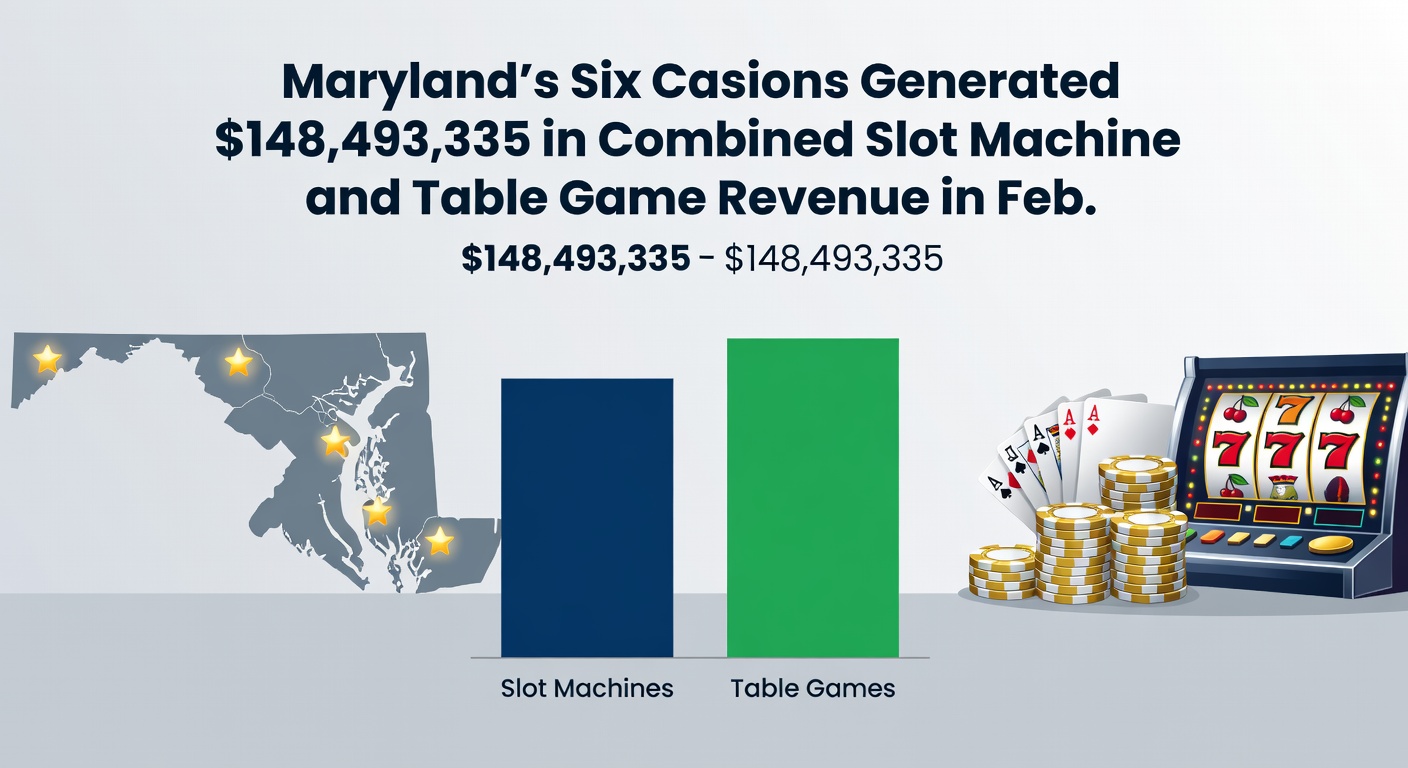
Maryland's six casinos collectively pulled in $148,493,335 from slot machines and table games during February 2026, a figure that reflects a 4.3% drop—or $6.7 million less—compared to the same month in 2025; data from industry reports highlights this shift amid steady operations at venues like MGM National Harbor, Live! Casino & Hotel in Hanover, Horseshoe Baltimore, Ocean Downs Casino, Rocky Gap Casino, and Hollywood Casino Perryville. And while total revenue dipped, the numbers still underscore the sector's scale, with slots typically driving the bulk—though exact breakdowns per game type remain consistent with patterns seen in prior months. What's interesting here is how this decline unfolds against a backdrop of seasonal factors, like shorter February days and post-holiday lulls, which experts have observed influencing foot traffic in brick-and-mortar spots.
Those who've tracked Maryland gaming for years point out that such year-over-year comparisons often reveal subtle pressures; for instance, milder weather in February 2026 might have kept some patrons closer to home, yet the casinos adapted by ramping up promotions and loyalty programs to hold steady where possible. Turns out, the aggregate drop masks varied performances across the board, but collectively, these establishments contributed significantly to state coffers despite the pullback.
State Contributions Take a Hit, Education Fund Feels the Pinch
State contributions from casino gaming slid 2.4% to $63.6 million in February 2026, including a notable $45.9 million directed to the Education Trust Fund—which itself saw a 2.5% decline from the previous year; figures from the Maryland Lottery and Gaming Control Commission revenue reports break this down clearly, showing how a portion of gross gaming revenue funnels directly into public programs. Observers note that this fund supports K-12 education initiatives across the state, so even modest dips carry weight in budget planning; the remaining contributions bolster local communities and other trusts, maintaining a structure that's been in place since the casinos launched over a decade ago.
But here's the thing: while the overall state take held relatively firm, the education slice's contraction draws attention from fiscal watchdogs, who monitor these flows monthly to gauge economic health. People in policy circles often find that gaming revenue acts as a reliable pillar—until external factors like competition or economic slowdowns nudge it sideways, as happened here.
Breaking Down the Performance Across Maryland's Casinos
Each of Maryland's six casinos plays a distinct role in the total; MGM National Harbor, the state's revenue powerhouse located just outside Washington, D.C., continues to lead with high-volume table games and slots drawing regional crowds, while Live! Casino & Hotel in Hanover leverages its resort amenities to sustain play. Horseshoe Baltimore thrives in the urban core, catering to city dwellers with a mix of high-stakes action and entertainment; meanwhile, Ocean Downs in Berlin focuses on harness racing alongside slots, Rocky Gap near Cumberland offers scenic slots amid mountain views, and Hollywood Casino Perryville rounds out the field with its Cecil County presence.
Data indicates that despite the collective 4.3% decline, some venues likely outperformed others—perhaps buoyed by targeted events or renovations—although aggregate reporting keeps specifics under wraps until detailed breakdowns emerge. Experts who've studied these patterns discover that perimeter casinos like Ocean Downs and Rocky Gap sometimes weather dips better due to lower operational costs, whereas flagship spots face stiffer competition from nearby Virginia and Pennsylvania outlets. And in February 2026, with Valentine's Day promotions lighting up floors, patrons still flocked, but not quite enough to match last year's pace.
Take one case from recent history: similar February slumps have rebounded in March as spring draws crowds outdoors and indoors alike; as of early March 2026, preliminary indicators suggest a potential uptick, though official numbers await release.
Seasonal Trends and Broader Market Context
February's shorter calendar—29 days in 2026 versus 28 in 2025—played a part, but experts attribute the bulk of the decline to maturing market saturation; Maryland's casinos, operational since 2010 for the first wave, now compete not just among themselves but with expanding neighbors, where Pennsylvania's slots and tables siphon cross-border play. Studies from gaming analysts reveal that year-over-year drops around 4% aren't uncommon in established U.S. markets, especially post-pandemic when initial booms leveled off; yet Maryland's figures remain robust, averaging over $140 million monthly and supporting thousands of jobs from dealers to hospitality staff.
What's significant is how this timing coincides with legislative sessions; lawmakers in Annapolis have long eyed gaming evolution, and February's data fuels those conversations. People who've followed the beat know that revenue stability—or lack thereof—often tips the scales in policy debates, with stakeholders from operators to educators weighing in.
Online Casinos Enter the Conversation as Lawmakers Deliberate
Amid this revenue dip, Maryland lawmakers ramped up discussions on legalizing online casinos in early 2026, viewing iGaming as a pathway to recapture lost dollars and tap untapped demographics; bills proposing regulated internet slots and tables have circulated for sessions, promising billions in new revenue without expanding physical footprints. Proponents, including casino operators who've tested digital waters elsewhere, argue that platforms could mirror successful models in New Jersey or Michigan—where online gaming surged past $1 billion annually—while generating fresh taxes for the Education Trust Fund and beyond.
Opponents counter with concerns over problem gambling and cannibalization of live casino play, but data from peer states shows online complements rather than supplants bricks-and-mortar; as of March 2026, hearings in the General Assembly draw testimony from industry leaders, with MGM and Live! executives reportedly supportive under strict regulations. Turns out, the February numbers provide timely ammunition, illustrating why diversification matters when physical revenue hits a plateau; researchers who've modeled scenarios project that iGaming could add $400 million yearly to Maryland's haul if greenlit.
One study highlighted how states with online options saw 10-15% overall gaming growth post-launch, even as live venues adjusted; for Maryland, where mobile betting already thrives via sportsbooks, extending to casino games seems a logical next step, though passage hinges on bipartisan buy-in and voter approval in some proposals.
And while February's decline grabs headlines, it's noteworthy that total handle—the amount wagered—often stays flat or rises, indicating engaged players just winning more or betting smarter; this nuance tempers the story, showing resilience beneath the surface stats.
Looking Ahead: March Indicators and Policy Horizons
Early March 2026 whispers of upticks emerge from casino trackers, with warmer weather and events like March Madness boosting sports-adjacent play; official February data, released mid-March, sets the stage for April forecasts, where experts anticipate stabilization around $150 million if trends hold. Those in the know emphasize that single-month dips rarely derail long-term trajectories—Maryland gaming has grown 20-fold since inception, funding over $2 billion annually statewide.
The ball's in lawmakers' court now, with online casino bills slated for votes; outcomes could reshape the landscape, blending digital innovation with proven live gaming strengths.
Key Takeaways from February's Report
- Total casino revenue: $148,493,335, down 4.3% year-over-year.
- State contributions: $63.6 million, a 2.4% decline.
- Education Trust Fund: $45.9 million, off 2.5%.
- Ongoing talks on iGaming signal potential expansion.
Conclusion
Maryland's February 2026 casino revenue figures paint a picture of a mature industry navigating familiar ebbs, yet poised for adaptation through legislative moves on online gaming; as data underscores the sector's vital role in state finances—especially education—the coming months will reveal whether physical declines prompt digital leaps forward, keeping